
Well over 21 million Americans have a permit to carry concealed. The number is likely higher, as 29 states now allow “Constitutional Carry”, and these folks are mixed in and out of known statistics. The numbers of folks who carry with little or no training is a matter of concern, as there are limitations, some lawful, some practical to the practice of walking out the door strapped.
I am a firearms enthusiast, not an expert. I carried a sidearm professionally for some 28 years, and lived through the metamorphosis from wheel guns (revolvers) to automatics, ostensibly to give law enforcement more firepower, increasing the number of rounds from around 6 to 15 or more in a single magazine. Various shootouts around the country pointed out the fallacy of being underarmed when confronting bad guys who were well armed. I am writing today to defend the seemingly ancient wheel gun for folks who no longer enjoy the hand strength necessary to run today’s automatic pistols. I am one of those folks.
Various studies indicate that the average armed encounter involves the expenditure of between 1 and 3 rounds when the encounter does not involve a law enforcement officer. As a practical matter, few law enforcement encounters involve the expenditure of more than 6 rounds. A law enforcement encounter is also more likely to involve an offensive posture as opposed to the nearly always defensive posture of a civilian involved shooting. Enter the venerable wheel gun.
I have carried a number of pistols in my lifetime and enjoyed range sessions with most of them. Today’s small hand cannons are not pleasant to shoot for the most part, but are far more concealable than full sized pistols. The same can be said for small revolvers, such as the J-frame guns made by Smith & Wesson, if you practice to any extent. My carry today is typically a J-Frame, 5 shot revolver in .38 Special. With custom grips it is virtually invisible, even under light summer clothing, and most importantly, easily run with hands compromised with arthritis. It is not practical for offensive situations (going after a “church” shooter and such) but plenty adequate for “get off me” defensive situations.
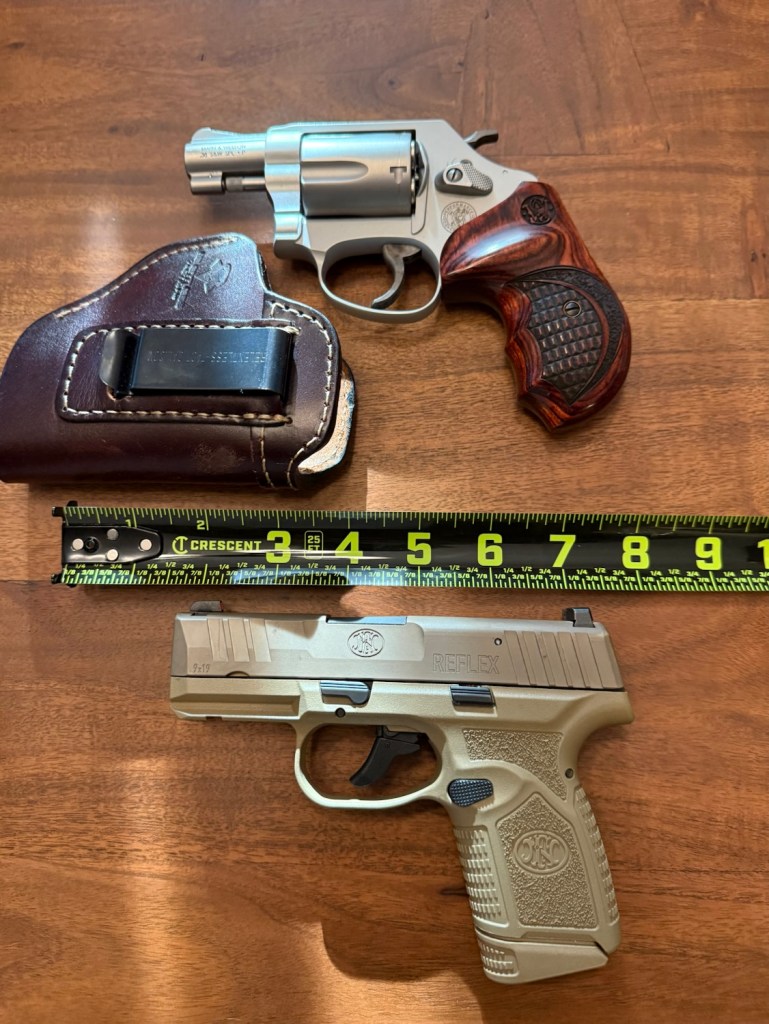
I will close with two advisories. First training is imperative as is practice. You must know the limitations of your carry and be proficient in its use. Training must also include the legal ramifications of any activity involving the use of a firearm. Secondly, in a small revolver with a short barrel, today’s hot defensive ammunition may not perform well in some popular calibers. These little guys do not generate enough velocity to cause the bullets to expand and penetrate as they would in a full sized pistol. Talk to a “gun guy” and he will explain the intricacies of ballistics and short barrels. You need penetration, not necessarily expansion.
I hope this helps. From time to time I get inquiries from friends and friends of friends about concealed carry, and this is my mantra. Train, practice and select the handgun that fits you. Are you one of the 21 millions folks who carry? It involves more than strapping one on and calling it good. Much more.
SR

